When a tap acts up in the middle of a shift, nobody has time to read an article. This chart puts the common draft problems on one page. Find what you see or taste, check the likely cause, and make the fix. The bottom of the chart shows your staff how to pour.
Download the printable PDF and hang it by your cooler or in the keg room. It prints on one letter-size page.
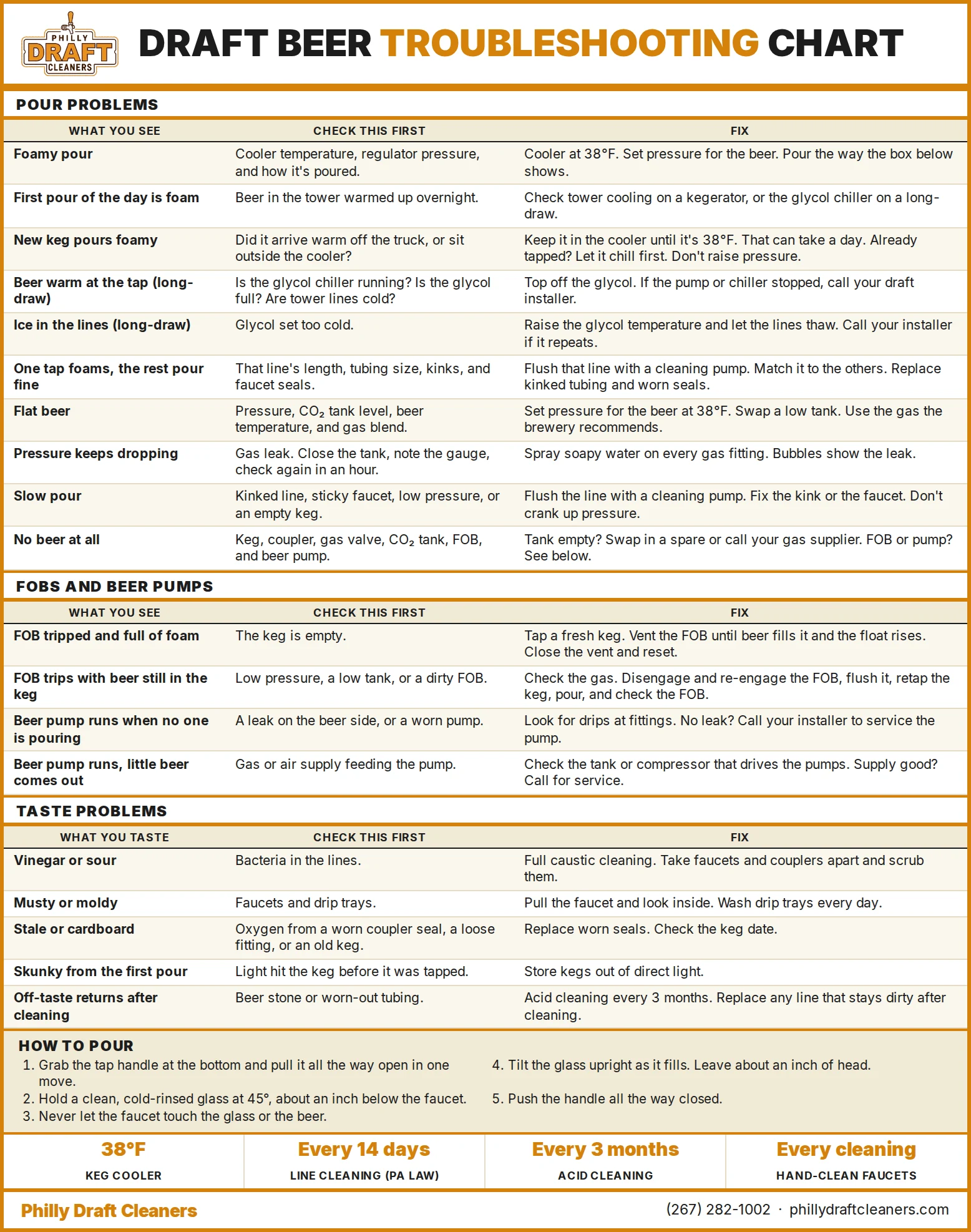
Pour Problems
- Foamy pour. Check: Cooler temperature, regulator pressure, and how it's poured. Fix: Cooler at 38°F. Set pressure for the beer. Pour the way the box below shows.
- First pour of the day is foam. Check: Beer in the tower warmed up overnight. Fix: Check tower cooling on a kegerator, or the glycol chiller on a long-draw.
- New keg pours foamy. Check: Did it arrive warm off the truck, or sit outside the cooler? Fix: Keep it in the cooler until it's 38°F. That can take a day. Already tapped? Let it chill first. Don't raise pressure.
- Beer warm at the tap (long-draw). Check: Is the glycol chiller running? Is the glycol full? Are tower lines cold? Fix: Top off the glycol. If the pump or chiller stopped, call your draft installer.
- Ice in the lines (long-draw). Check: Glycol set too cold. Fix: Raise the glycol temperature and let the lines thaw. Call your installer if it repeats.
- One tap foams, the rest pour fine. Check: That line's length, tubing size, kinks, and faucet seals. Fix: Flush that line with a cleaning pump. Match it to the others. Replace kinked tubing and worn seals.
- Flat beer. Check: Pressure, CO₂ tank level, beer temperature, and gas blend. Fix: Set pressure for the beer at 38°F. Swap a low tank. Use the gas the brewery recommends.
- Pressure keeps dropping. Check: Gas leak. Close the tank, note the gauge, check again in an hour. Fix: Spray soapy water on every gas fitting. Bubbles show the leak.
- Slow pour. Check: Kinked line, sticky faucet, low pressure, or an empty keg. Fix: Flush the line with a cleaning pump. Fix the kink or the faucet. Don't crank up pressure.
- No beer at all. Check: Keg, coupler, gas valve, CO₂ tank, FOB, and beer pump. Fix: Tank empty? Swap in a spare or call your gas supplier. FOB or pump? See below.
FOBs and Beer Pumps
FOBs (foam on beer detectors) stop the line when a keg runs out, so you don't pour foam into the lines. Long-draw systems with long runs often use gas-driven beer pumps to move beer to the bar.
- FOB tripped and full of foam. Check: The keg is empty. Fix: Tap a fresh keg. Vent the FOB until beer fills it and the float rises. Close the vent and reset.
- FOB trips with beer still in the keg. Check: Low pressure, a low tank, or a dirty FOB. Fix: Check the gas. Disengage and re-engage the FOB, flush it, retap the keg, pour, and check the FOB.
- Beer pump runs when no one is pouring. Check: A leak on the beer side, or a worn pump. Fix: Look for drips at fittings. No leak? Call your installer to service the pump.
- Beer pump runs, little beer comes out. Check: Gas or air supply feeding the pump. Fix: Check the tank or compressor that drives the pumps. Supply good? Call for service.
Taste Problems
Before you blame the lines, pour the same beer from a can or bottle if you have one. If the package tastes fine and the draft doesn't, the problem is in your system.
- Vinegar or sour. Check: Bacteria in the lines. Fix: Full caustic cleaning. Take faucets and couplers apart and scrub them.
- Musty or moldy. Check: Faucets and drip trays. Fix: Pull the faucet and look inside. Wash drip trays every day.
- Stale or cardboard. Check: Oxygen from a worn coupler seal, a loose fitting, or an old keg. Fix: Replace worn seals. Check the keg date.
- Skunky from the first pour. Check: Light hit the keg before it was tapped. Fix: Store kegs out of direct light.
- Off-taste returns after cleaning. Check: Beer stone or worn-out tubing. Fix: Acid cleaning every 3 months. Replace any line that stays dirty after cleaning.
How to Pour
A lot of foam comes from the pour itself. Train every bartender on these five steps, following the Brewers Association's pouring guidance.
- Grab the tap handle at the bottom and pull it all the way open in one move.
- Hold a clean, cold-rinsed glass at 45°, about an inch below the faucet.
- Never let the faucet touch the glass or the beer.
- Tilt the glass upright as it fills. Leave about an inch of head.
- Push the handle all the way closed.
The Numbers to Remember
- 38°F for the keg cooler, per the Brewers Association Draught Beer Quality Manual.
- Every 14 days for line cleaning. Pennsylvania requires it under 40 Pa. Code § 5.51.
- Every 3 months for an acid cleaning to remove beer stone.
- Every cleaning, faucets and couplers come apart and get scrubbed by hand.
Still Stuck?
Some problems have more than one cause stacked together. A warm cooler and a dirty line can both make the same tap foam. For more detail, read why draft beer gets foamy, why draft beer goes flat, and what an off-taste means.
If you've worked through the chart and a tap still won't pour right, call (267) 282-1002. We'll come look at the whole system.